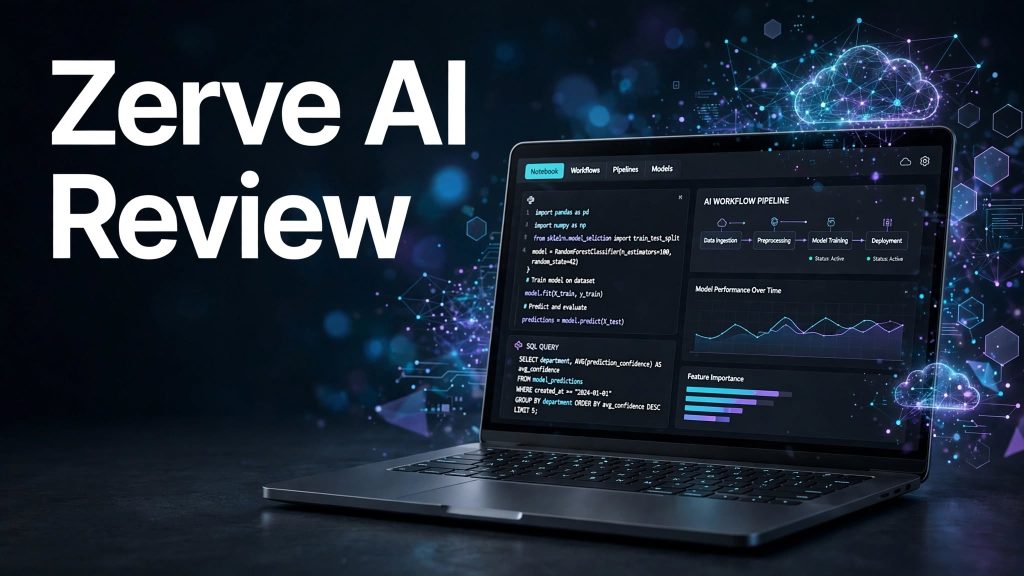
Working with large datasets, building machine learning models, and generating meaningful insights can be challenging. Data professionals often need multiple tools for coding, analysis, collaboration, and deployment.
Zerve AI aims to simplify these processes by bringing AI agents, data analysis, notebooks, computing resources, and deployment tools into one platform.
It helps data scientists, researchers, and analysts explore data, build workflows, generate reports, and turn their analysis into production-ready applications. But is Zerve AI worth using? Let’s explore its features, pricing, advantages, and limitations.
What Is Zerve AI?

Zerve AI is an AI-powered platform designed for data science, research, analytics, and machine learning workflows.
It combines AI agents with an interactive notebook environment, allowing users to work with data, write and execute code, analyze results, and deploy applications.
The platform supports analytical programming languages such as Python, SQL, R, and GraphQL. It is particularly useful for teams that want to move from data exploration to practical business insights without managing multiple disconnected tools.
What Can You Do With Zerve AI?
AI-Powered Data Analysis
Zerve includes an AI agent that understands data structures, relationships, code, and project context. Users can describe their analytical requirements in natural language, and the agent can help write code, build data pipelines, investigate patterns, and validate results.
AI-Native Notebooks
Its interactive notebook environment combines code, data, visualizations, and execution results in one workspace.
Users can work with multiple programming languages, collaborate on projects, maintain reproducible workflows, and manage code through Git integration.
Data Discovery and Research

Zerve can connect with data warehouses and sources such as BigQuery, Snowflake, Redshift, and S3. Its data discovery capabilities help map schemas, identify relationships, and establish context before analysis begins.
This can make it easier for analysts and researchers to explore complex datasets.
Reports, APIs, and Deployments
Zerve allows users to turn analytical results into interactive reports, applications, dashboards, APIs, and scheduled jobs.
Instead of stopping at data analysis, teams can deploy their work into practical systems and share insights with other stakeholders.
Zerve AI Pricing
Zerve AI offers pricing options based on individual usage and organizational requirements. Its dedicated pricing page currently emphasizes customized Enterprise pricing.
- Enterprise: Custom pricing based on deployment model, team size, computing requirements, and support needs.
- Enterprise Trial: A free, no-obligation trial is available for organizations that want to evaluate the platform within their own environment.
- Individual Access: Zerve also provides a free starting option through its platform, with usage and compute allowances subject to the applicable account terms.
Since pricing and available plans may depend on the selected setup, businesses should contact Zerve for a customized quotation before subscribing.
Is Zerve AI Easy to Use?

Zerve is designed to make complex data workflows more manageable through AI assistance and an interactive notebook interface.
Users can describe tasks, generate code, inspect results, and collaborate within the same workspace.
However, beginners may need some knowledge of data analysis, programming, and machine learning to use its advanced capabilities effectively. Enterprise implementations may also require technical configuration.
Pros and Cons of Zerve AI
Pros
- AI-powered data analysis and research.
- Context-aware AI agents.
- Interactive, multi-language notebooks.
- Python, SQL, R, and GraphQL support.
- Automated data discovery.
- Parallel computing capabilities.
- Git-native version control.
- Reports, dashboards, and API deployments.
- Enterprise security and private deployment options.
Cons
- Advanced features may require technical knowledge.
- Enterprise pricing requires a sales consultation.
- Complex implementations may need IT support.
- The platform may be more than beginners need.
- Computing and usage allowances depend on the selected plan.
Who Is Zerve AI Best For?
Zerve AI is suitable for data scientists, data analysts, researchers, machine learning engineers, quantitative researchers, and enterprise data teams.
It is particularly useful for organizations working with large datasets, building predictive models, automating analytical workflows, and converting research into production applications.
Is Zerve AI Worth It?

Zerve AI is worth considering for teams that want to combine AI assistance, data analysis, collaborative notebooks, and deployment capabilities in one environment.
Its context-aware agents, data discovery, reproducible workflows, and enterprise deployment options make it a useful solution for complex analytical projects.
However, smaller teams with basic reporting requirements may not need all its advanced capabilities. Businesses should evaluate their technical requirements, infrastructure, and pricing before making a decision.
Final Verdict
Zerve AI offers a powerful environment for modern data science and AI-powered research. Its combination of intelligent agents, interactive notebooks, scalable computing, reporting, and deployment tools helps teams move from raw data to usable results.
Although advanced workflows may require technical expertise and enterprise pricing is customized, Zerve AI is worth exploring for organizations that want to make their data operations more efficient.
Frequently Asked Questions
What is Zerve AI used for?
Zerve AI is used for data analysis, machine learning, research, data discovery, workflow automation, reporting, and application deployment.
Does Zerve AI support Python?
Yes. Zerve supports Python, SQL, R, and GraphQL for analytical and development workflows.
Does Zerve AI offer a free option?
Yes. Zerve provides a free starting option, and enterprise customers can request a free evaluation trial.
Can Zerve AI deploy applications?
Yes. Users can turn their notebooks into APIs, web applications, dashboards, and scheduled jobs.
Does Zerve AI support enterprise deployment?
Yes. It supports managed cloud, self-hosted cloud, on-premises, and air-gapped deployment options.
Who should use Zerve AI?
Data scientists, analysts, researchers, machine learning engineers, and businesses managing complex data workflows can benefit from Zerve AI.